Artistic Chapter

The Original Score

Already one of the film's strongest dimensions, the music now becomes a central pillar of the new cinematic version.

Music conceived for the big screen

The music of The Legend of Akam was never conceived as simple accompaniment. From the very beginning, it was imagined as one of the film's own voices. Written to carry a story of adventure, emotion and transmission, it follows the Pantanal's metamorphoses, the power of its landscapes, danger, tenderness, humor and the almost mythological dimension of Akam's journey. The ambition was that of true film music: expansive when it must embrace the territory, intimate when it draws close to the characters, able to fade before silence and then suddenly take its full place in the narrative. A score built around themes and motifs that return, evolve and transform with the characters. This original score is now one of the most precious legacies of the first film. It will be preserved, expanded and reorchestrated for the new version of The Legend of Akam, in order to give it the full sonic scale of the new film.

Two composers, one shared score

Bruno Vouillon

Bruno Vouillon

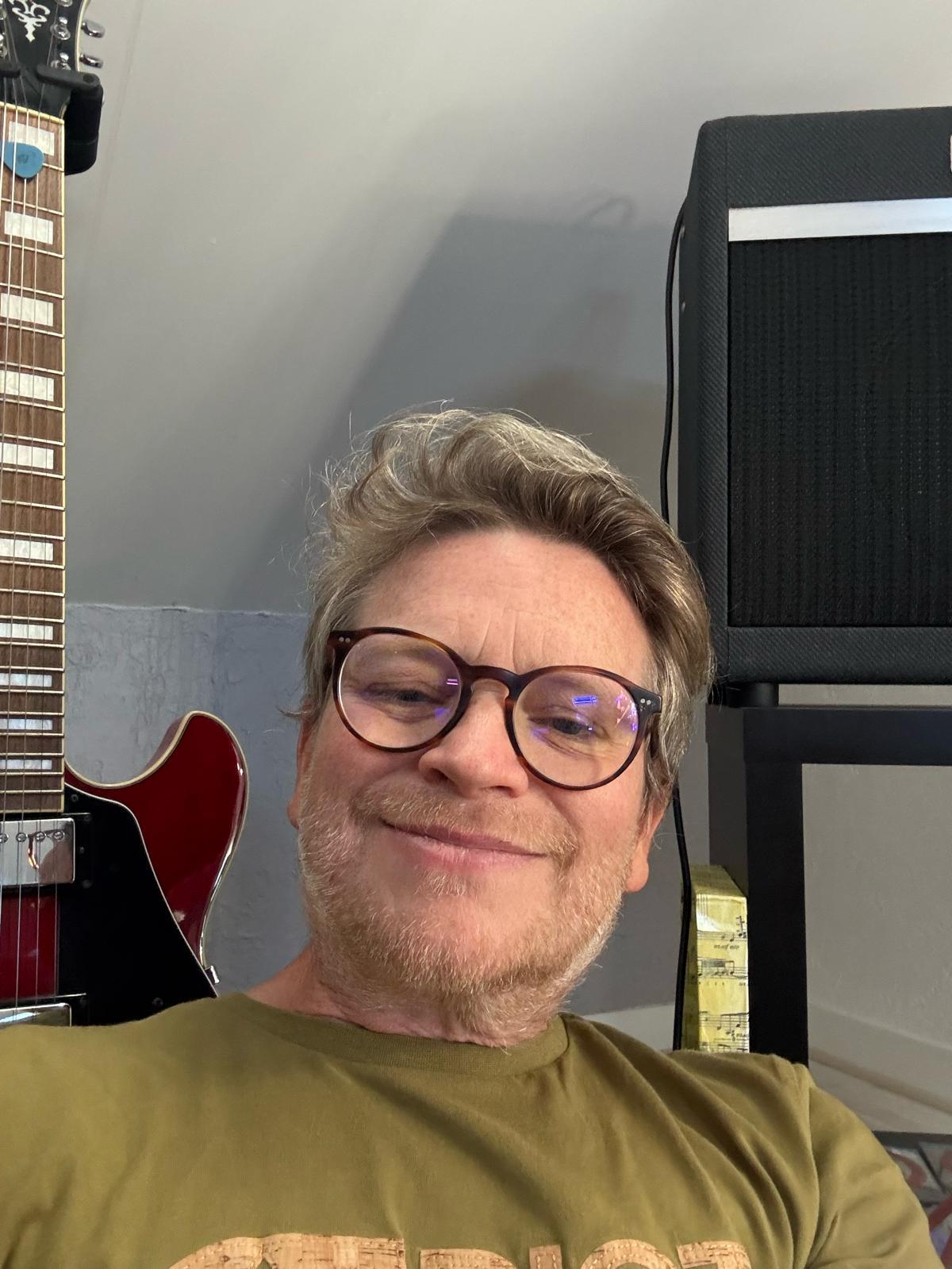
Multi-instrumentalist, composer and music director, Bruno Vouillon began with guitar before quickly expanding his world to piano, bass guitar and double bass. He took his first major steps on the international electronic scene alongside Llorca (F-COM), touring from 2001 to 2003 across Europe, Canada, the United States and Australia, including performances at the Montreux Jazz Festival, the Paleo Festival, New York and opening for Jamiroquai. He also accompanied several international artists, including Tomuya at the Olympia. Since then, Bruno Vouillon has divided his activity between composition, music production, programming and instrumental sessions. He has notably collaborated with David Linx, Ken Norris and Jan Stumke, contributed to Beatrice Ardisson compilations, and created arrangements for Peter Kingsbery of Cock Robin. His path also naturally led him to original scores and sonic worlds for documentary and fiction. In The Legend of Akam, this wide musical culture feeds a score that can move from orchestral to intimate, and from spectacular to organic.

Sacha Menu

Sacha Menu

Composer, guitarist and bassist, Sacha Menu grew up in a deeply musical family environment. After piano, he chose guitar and joined the Toulon Jazz Conservatory. From the age of fifteen, he pursued his studies while working professionally on stage. This live experience led him to accompany many artists on French and European stages, notably at the Olympia and in several Zenith arenas. Passionate about cinema, he later dedicated himself to music for picture and composed original scores for numerous documentaries and fiction films, notably broadcast by Arte, TV5 Monde and the thematic channels of the TF1 group. In 2022, the Centre National de la Musique awarded him a creation grant that enabled him to compose a conceptual EP dedicated to global warming. His dual culture as a stage musician and screen composer nourishes writing that is especially attentive to rhythm, dramaturgy and emotion.

01

A score that evolves with the film

The new version of The Legend of Akam does not simply mean creating new images. The entire film is being rethought as a contemporary cinematic work, and its music will undergo the same transformation. The original themes that form the film's musical identity will be preserved, but may be developed, reorchestrated, extended or reinterpreted according to the new dramaturgy. The goal is therefore not to replace the original score, but to offer it a second life and a new dimension, in line with the visual ambition of the film.

02

Sound as cinematic material

In a film where animals speak and no human narrator comes to explain what the audience should watch or feel, sound itself becomes an element of staging. The musical and sound design of the new version will therefore be fully reworked with the same level of demand as the image: voices, music, natural ambiences, silences, movement, landscape texture and sound effects will be conceived as the layers of one single universe. The Pantanal will not only be seen. It must be heard, felt, almost inhabited. The boundary between music and environment may at times dissolve: a beat, a breath, a distant cry, water or wind may become rhythm; conversely, music may be born almost imperceptibly from the landscape.

03

A musical identity beyond the film

The musical ambition of The Legend of Akam does not stop at the end credits. Its themes are designed to exist beyond the images: an original soundtrack that can be listened to as a standalone musical work, but also a sonic identity able to accompany Akam's universe over time. Because if The Legend of Akam tells a story, its ambition is also to create a world recognizable from its very first notes.

04

A song to extend the story

The end credits were also conceived as a moment in their own right. Its original song was not composed as a simple track meant to accompany the film's final images. It was written with a different ambition: to bring to life a song capable of one day leaving the film to live its own story. A melody one can remember, return to, share and listen to independently from The Legend of Akam — while still remaining immediately linked to its universe and the emotion of its conclusion. The film ends. The song can continue.